
Mortgage Adviser Auckland: Free, Independent Advice
Mortgage broking for Auckland buyers. We compare 25+ lenders for your home loan, factor in the Auckland complexities around apartment size caps, cross lease titles and Plan Change 120 zoning, and manage the whole application online.
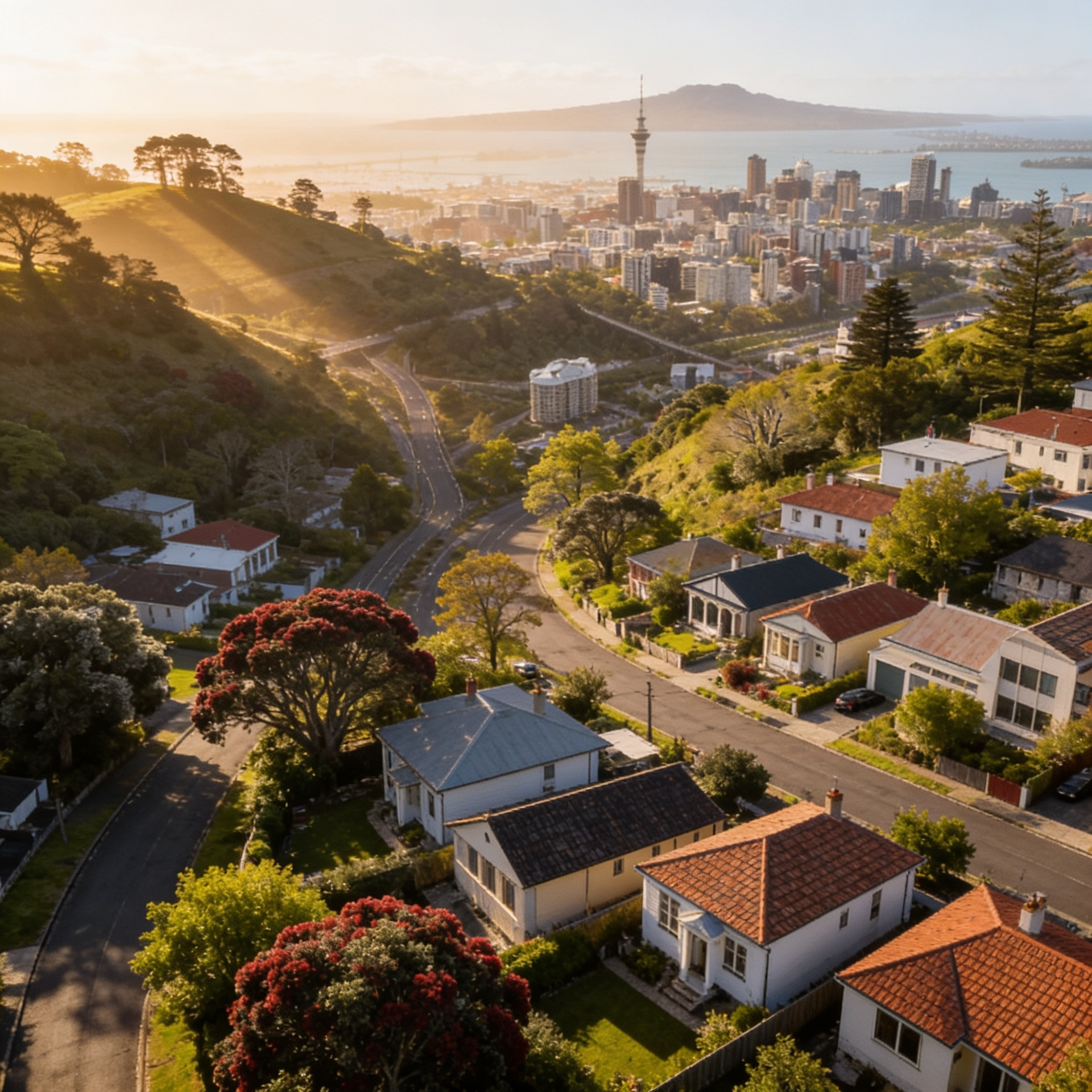
Auckland Property Market Snapshot
Auckland is by far New Zealand's largest housing market and its most complex one. Prices, suburbs, and lending rules vary more here than anywhere else in the country.

Auckland is New Zealand's most expensive market
Median house prices across the three main centres, early 2026.
Auckland's median sits at $1.04 million, roughly 16% above Wellington and 44% above Christchurch. The price gap is the main reason Auckland buyers lean heavily on the First Home Loan, KiwiSaver, and parental gifting to make the deposit work.
Inventory is sitting at 41 weeks, which means buyers have choice. Activity is up year on year too, with Auckland recording its highest February sales count since 2021 (REINZ March 2026 Property Report).
Pick your situation. We'll tell you what the Auckland market is doing for you right now.
Days to sell is above the long run average and inventory is high. There's room to negotiate, room to take your time, and room to walk away from properties with apartment, cross lease, or leaky build issues that lenders won't touch.
Inventory 41 weeks, days to sell 53FHBs made up 30% of all Auckland purchases in Q1 2026, but the entry price gap is huge. A full 20% deposit on the Auckland median is $208,000, which is why most Auckland FHBs lean on the 5% deposit First Home Loan instead.
30% of Auckland purchases Q1 2026Auckland's average gross yield on three bedroom stock was 3.61% in March 2026, below Christchurch's 4.4 to 4.6%. Auckland is the capital growth play, not the cashflow play. Higher yields are concentrated in Drury, Auckland Central apartments, Clendon Park, Papakura, and Manurewa.
Citywide gross yield 3.61%Auckland Suburbs at a Glance
Click a suburb on the map to see its average price, who's buying there, and how it stacks up. Auckland is really six or seven property markets stacked on top of each other, the right suburb depends on whether you're chasing a first home, a family upgrade, or a rental yield. Figures are average sale prices for three bedroom properties from the Barfoot & Thompson March 2026 suburb report.
Manurewa
One of the most affordable South Auckland entry points and a strong yield play. Steady FHB and investor demand from a deep tenant market.
Papakura, Manurewa, Mangere, Otahuhu, Pukekohe, Henderson, Glen Eden, Massey, Flat Bush and New Lynn all sit below $900,000 on average for three bedroom stock. South and West Auckland are where the entry level market is concentrated.
Auckland's higher gross yields on three bedroom stock are concentrated in Drury (5.43%), Auckland Central apartments (4.78%), Clendon Park (4.77%), Papakura (4.66%), Takanini and Opaheke (4.64%), and Manurewa (4.51%). Premium central suburbs sit well below 3%, a capital growth play, not cashflow.
Barfoot's March 2026 data showed the 12 month average sale price was lower than the year before in Central Auckland, Central Auckland East, Central Auckland West and the Eastern Suburbs. Established premium areas have been the weak spot.
Buying Your First Home in Auckland
Auckland is the hardest first home market in New Zealand on price, but it's one of the most active. First home buyers made up 30% of all Auckland purchases in Q1 2026, FHBs are absolutely buying, just not in Remuera.
How the First Home Loan (Kāinga Ora) works
The First Home Loan is a 5% deposit scheme underwritten by Kāinga Ora and offered through select participating lenders. To qualify, you need to:
- Be over 18 and a New Zealand citizen, permanent resident, or resident visa holder.
- Be a first home buyer (or a previous homeowner in a similar financial position).
- Earn under $95,000 before tax as an individual buyer, $150,000 as an individual with dependants, or $150,000 combined for multiple buyers.
- Have a minimum 5% deposit of the purchase price.
- Buy the home as your primary place of residence.
There is no regional house price cap on the First Home Loan. The income caps and the lender's serviceability assessment determine what you can buy. That matters in Auckland, because the old regional caps used to lock buyers out of the median. Full eligibility details sit in the Kāinga Ora First Home Loan brochure.
A Lender's Mortgage Insurance premium also applies (around 0.5% of the loan amount), payable upfront or added to the loan over its lifetime.
Which lenders offer the First Home Loan?
Eight lenders are currently participating: ASB, Westpac, Kiwibank, The Co-operative Bank, SBS Bank, Unity, Nelson Building Society, and NZHL. ASB joined the panel in February 2026.






Building Society
ANZ and BNZ are not on the panel. That matters in Auckland: if you're going low deposit, your shortlist of lenders is narrower than for a standard application. We'll match you to the participating lender most likely to approve your specific situation.
KiwiSaver and your deposit
KiwiSaver is usually part of the deposit rather than the whole thing. You can withdraw from your KiwiSaver if you've been a member for at least three years and leave at least $1,000 behind. For most Auckland FHBs that means combining KiwiSaver with cash savings, a gift, or a guarantor. KiwiSaver alone is rarely enough at Auckland prices.
A note on the First Home Grant: the Government closed the grant to new applications on 22 May 2024. It is no longer available for any new buyer in Auckland or anywhere else.
Is this your situation?
You and your partner have around $30,000 in savings and a combined $55,000 in KiwiSaver. That's $85,000 together, exactly 10% of an $850,000 South or West Auckland home. Your bank has told you that you need 20%, so you've put it on hold.
Here's how the picture changes with the First Home Loan: the same $85,000 is enough to buy at 5% deposit through one of the eight participating lenders, with $42,500 still left over for legal, building reports, and reserves. We'd model your full numbers and tell you whether to move now or save another six months.

Investing in Auckland Property
Auckland is the capital growth market, not the cashflow market. Yields sit below the rest of the country, but the rental market is the deepest in NZ and long run capital growth has been higher than the national average. The trade off is well documented and worth understanding before you buy.
Citywide gross yield 3.61% on three bedroom stock (Barfoot, March 2026). Higher yields concentrate in Drury (5.43%), Auckland Central apartments (4.78%), Clendon Park (4.77%), Papakura (4.66%) and Manurewa (4.51%).
Scale and depth. Auckland is a bigger, deeper rental market than anywhere else in NZ. Auckland average weekly rent on three bedroom stock was $702, and Auckland Central three bedrooms averaged $1,000 per week.
New build supply in growth corridors (Drury, Pukekohe, Hobsonville Point, Karaka) qualifies for lower investor LVR thresholds, currently 70% on standard purchases versus 65% on existing stock.
Investors are re-engaging. Cotality noted investors have been coming back more cautiously, helped by lower mortgage rates and reduced top ups on rentals compared with the 7% mortgage rate period.
The trade off here isn't earthquake hazard, it's building stock complexity. Auckland has more apartments, more cross lease titles, more leaky build era stock, and a more aggressive intensification framework than any other city in New Zealand. All four affect lending. We cover them in detail in the next section. Tax note: Inland Revenue's interest deductibility rules and bright line test apply, and major weathertightness remediation is generally treated as capital expenditure (not deductible).
Read our full Property Investment guideNew Builds in Auckland's Growth Corridors
A growing share of Auckland buying is happening in the new build market. By 2023 to 2024, 60% of all Auckland residential building consents were for multi unit complexes (townhouses, terraced housing, or apartments), up from 34% in 2019 to 2020.
From 1 December 2025, owner occupiers can borrow up to 90% on standard purchases (cap at 80% on existing homes), and investors up to 70% (versus the standard cap on existing stock). New builds typically sit above those caps.
(
(
Why new builds make finance easier in Auckland
Owner occupiers can borrow up to 90% and investors up to 70% on standard new build purchases. RBNZ LVR rules.
Your KiwiSaver first home withdrawal can be used for new build deposits exactly as it can for existing homes. No extra hoops.
Construction loans are interest only while the house is being built. You're not paying full repayments while you wait to move in.
Major new build areas in Auckland
Greenfield growth corridor in southern Auckland. Strongest published yield (5.43%) and a major pipeline of new land releases.
Southern fringe town with greenfield development. More affordable median than central Auckland.
Southern lifestyle and house and land. Bigger sections, semi rural feel, premium new build prices.
Masterplanned northwestern community. Mix of terraced housing, apartments, and standalone, with ferry access to the city.
Northwestern growth zones with new infrastructure and a long pipeline of land releases.
Established North Shore new build hub. Big subdivisions, modern homes, good schools.
Eastern Auckland infill and townhouse hub. Walkable centre, good schools, strong family buyer demand.
Coastal masterplanned community on the East Coast Bays. Beach access, contemporary homes.
Auckland Council's Development Contributions Policy (effective 1 July 2025) sets average DCs of ~$48,000 per dwelling in Investment Priority Areas (Inner Northwest, Drury, Mangere, Mt Roskill, Tāmaki) and ~$20,000 per dwelling elsewhere. Watercare's Infrastructure Growth Charges are separate and Watercare is increasing IGCs by 15.5% in the 2026 financial year. Source: Auckland Council development contributions.
We'll match you to a lender whose construction policy fits your build type, walk you through the drawdown schedule, and itemise the development contributions and Watercare charges before you sign.
Apartments, Leaky Homes, Cross Lease and Plan Change 120
Four Auckland-specific issues that affect mortgage approval and deposit requirements. None of them come up in the rest of New Zealand. Select a topic to expand.
Each bank sets a minimum apartment floor area for standard 20% deposit lending. Below that threshold, you'll need a much larger deposit or may not be able to borrow at all.
| Bank | Min size for 20% deposit | Below minimum |
|---|---|---|
| ANZ | 38 sqm freehold, separate bedroom and living | 50% deposit; same applies to studios and leasehold |
| ASB | 40 sqm, studios without carparks accepted at 20% | Higher deposit required below 40 sqm |
| BNZ | 50 sqm | 35% deposit or decline. Strictest of the major banks |
| Kiwibank | 40 sqm | Higher deposit or decline |
| Westpac | 40 sqm | 50% deposit |
Source: interest.co.nz, June 2021 and ANZ, July 2021. Individual policies shift but the framework holds.
- These are bank lending floors, not council rules. Councils removed minimum apartment size requirements for new builds in 2024, so apartments under 30 sqm can legally be built but banks still won't lend on them at standard deposit terms.
- Leasehold apartments are treated as non-standard security. ANZ requires a 50% deposit on leasehold, the same as sub-threshold size apartments.
- Body corporate fees of $3,000 to $10,000+ per year count as a committed expense in serviceability calculations and directly reduce your borrowing power.
- Banks monitor building exposure, tracking how many units in a single tower they're already lending against, particularly in central Auckland.
Auckland was one of the four local authorities most significantly affected by the leaky homes crisis, accounting (with Christchurch, Tauranga and Wellington) for 95% of all properties with active claims as at January 2013 (Office of the Auditor-General, 2013). The problem era: timber-framed buildings with monolithic plaster cladding, constructed primarily between 1994 and 2004.
- A builder's report flagging moisture ingress typically triggers a specialist moisture report requirement. Confirmed damage may lead to a decline or a requirement to hold repair funds upfront before settlement.
- Confirmed but unremediated weathertightness issues make approval generally difficult. Lenders may lend conditionally if remediation is certified by a qualified professional, assessed case by case.
- Insurance is the second hurdle. Banks require ongoing insurance for the duration of the mortgage. If a property can't be insured, lending falls over.
- Get a LIM from Auckland Council and check for any weathertightness or building defect notices.
- Commission a specialist building surveyor on any property built between 1988 and 2004 with monolithic or plaster-style cladding.
- Request the full council file: consent history, code compliance certificate, and any complaint or remediation records.
- Order a dedicated moisture report if you see plaster cladding, minimal eaves, complex rooflines, or deck flashings.
- Check for any outstanding body corporate claims or levies related to weathertightness.
Cross lease and unit title properties account for 31% of all titles in Auckland, with 44% of those having dwellings built in the 1970s or earlier (Knowledge Auckland). Most banks lend on cross lease on similar terms to freehold when the title is clean. Problems start when:
- The flat plan on the lease doesn't match the actual building, usually because of unconsented additions or alterations.
- The lease is defective, missing, expired, or not properly registered. Older 1970s cross leases are common offenders.
- Neighbour consent is required for alterations and can't be obtained.
- Insurance arrangements between cross-leaseholders are unclear or in dispute.
Where any of those exist, banks may decline, impose conditions, or require legal opinion on title. Converting to freehold is the long-term fix. Key numbers:
Auckland's Unitary Plan defines what can be built on a site, which flows directly into lender valuations and resale value. The four main residential zones:
Low-density single-dwelling sites, typically 1 to 2 storeys. Least permissive.
Auckland's most widespread residential zone. Two-storey detached and attached housing.
Up to three storeys. Townhouses and terraces around centres and transport corridors.
Apartments and terrace housing near centres and rapid transit. Highest-density zone.
- Auckland Council notified Plan Change 120 on 3 November 2025 to replace the contested Plan Change 78.
- Central government legislation receiving Royal Assent on 3 April 2026 reduced the minimum housing capacity requirement to approximately 1.4 million homes, a 32.5% reduction from PC78.
- PC120 proposes upzoning many MHS sites to MHU (2 to 3 storey) and enabling 10 to 15 storey buildings around major transport hubs and town centres.
- Some PC120 rules already have immediate legal effect. The Medium Density Residential Standards (MDRS) no longer apply in Auckland; PC120 is Auckland's tailored replacement.
Banks lend against current use, not development potential. On upzoned sites, market prices often sit above the bank's as-is valuation, meaning you may need to fund the gap from your own equity. We match your application to the lender most comfortable with the scenario.
Most mortgage advice is written for standalone house buyers. Apartments, cross leases, leaky build paperwork, and Plan Change 120 zoning don't feature on most national broker pages, because outside Auckland they either don't exist or don't matter. We've placed loans on small CBD apartments, worked through cross lease title defects, and know which lender to take a plaster-clad 1990s house to. That's the actual reason to use an Auckland-focused broker over a generic call centre line.
Your Auckland Mortgage Adviser
Auckland clients served entirely online, with bank side experience and a way of working that fits around work, kids, and Auckland traffic.

Bachelor of Finance, Masters of Engineering Management, and a decade inside the banking industry, including time as a Commercial Manager at ASB Bank, where he pioneered digital banking solutions for shared home ownership.
The bank side experience means he knows how applications are assessed, what triggers declines, and how to structure lending so it gets approved. Seb is also an active property investor and developer, so he's been through the lending process himself, on both sides of the table.

Beka handles client and bank liaison and loan applications from start to finish. She specialises in working with first home buyers: KiwiSaver withdrawals, First Home Loans, deposit structuring, and everything in between.
If you're an Auckland FHB navigating the 5% deposit route at Auckland prices for the first time, Beka is the one walking you through every step.
Everything is online. The entire process, from the first chat to signing your loan documents, runs over Zoom, phone, and email. You don't need to come into an Auckland office and we don't need to come to you. That's how most Auckland clients prefer it: it fits around work, kids, and Auckland traffic. The application, document signing, and settlement all happen digitally.
Simpler is a registered Financial Service Provider (FSP761131) and operates under New Zealand's financial advice regulations.
What our clients say
Don't just take our word for it, hear from the people we've helped.










Auckland Mortgage Questions, Answered
The questions we hear most from Auckland buyers.
That depends on your income, your existing debts, your deposit and the lender's test rate, not on the suburb. As a rough guide, most banks lend around 5 to 6 times annual household income, but the test rate they use is usually 1.5 to 2% above the actual rate you'd pay. With Auckland's regional median sitting at $1,040,000, the gap between borrowing power and target price is the main constraint for most buyers. We run the numbers across multiple lenders so you know your real maximum, not just one bank's estimate.
Papakura, Manurewa, Mangere, Otahuhu, Pukekohe, Henderson, Glen Eden, Massey, Flat Bush and New Lynn all sit below $900,000 on average for three bedroom stock (Barfoot March 2026). South Auckland and West Auckland are where the entry level market is concentrated. The best suburb also depends on whether you want a townhouse, a unit, or a standalone, and whether you need a participating First Home Loan lender.
Howick, Pakuranga, Te Atatu Peninsula, Glenfield, Birkenhead, Botany Downs, Half Moon Bay, Avondale and parts of Mt Albert all sit in the $940,000 to $1.15 million range on three bedroom average pricing. That's the typical "stretch" tier for FHBs and second time buyers who want established suburbs.
Sometimes. Above each bank's minimum size threshold, you can get standard 20% deposit lending (or 10% for new builds with LVR exemptions). Below the threshold you'll typically need a 35 to 50% deposit. ANZ requires 50% on apartments under 38 sqm, BNZ requires 35% (or declines) below 50 sqm, ASB, Kiwibank and Westpac require higher deposits below 40 sqm. We'll match the apartment to the right bank.
Bank minimums sit between 38 sqm and 50 sqm depending on the lender. ANZ is the lowest at 38 sqm, BNZ is the strictest at 50 sqm. Studios, leasehold apartments and apartments under the threshold still get loans, just at higher deposits.
Banks count body corporate levies as a committed expense in serviceability calculations. Auckland body corporate fees commonly run $3,000 to $10,000 per year, with older buildings generally higher. Higher fees mean less borrowing power. We'll factor body corp into your maximum before you make an offer.
Yes, the at risk period is timber framed buildings constructed mainly between 1994 and 2004 with monolithic plaster cladding. Banks require a moisture report if a building inspection flags moisture ingress, and may decline or require repair funds set aside before settlement. Insurance is the second hurdle, if a property can't be insured, lending falls over. Always order a specialist building survey on plaster clad 1990s to early 2000s stock.
Around $18,000 to $25,000+GST per title in 2026, depending on complexity. Typical timeframe is 3 to 6 months. Conversion can add 7 to 20% to the sale price on disposal and removes title risk that some lenders don't like.
Closer to buyer friendly to balanced. Days to sell were 53 in March 2026 (above the 10 year average of 50), and inventory sat at 41 weeks, buyers have choice. Annual price growth was 0.5%.
Drury (5.43%), Auckland Central (4.78%), Clendon Park (4.77%), Papakura (4.66%), Opaheke (4.64%), Takanini (4.64%), Pokeno (4.52%), Favona (4.52%), Manurewa (4.51%) and Northcross (4.49%) lead Auckland yields on three bedroom stock as at March 2026. Citywide gross yield averages 3.61%, well below Christchurch's 4.4 to 4.6%.
Indirectly, yes. Banks lend on "as is" valuations, not redevelopment potential, so on upzoned MHU/THAB sites the market price often exceeds the bank valuation, meaning you may need to fund the gap from equity. Special Character Areas restrict redevelopment, which can limit resale capital growth versus nearby non SCA sites. Plan Change 120 is still in hearings as at April 2026 but some rules already have legal effect.
No. We run everything online, Zoom, phone, and email. You don't need to come into an office. Most Auckland clients prefer it that way: it fits around work, kids, and a long commute. The application, document signing, and settlement all happen digitally.
Nothing. We're paid by the lender when your loan settles. There's no fee to you, no charge for the chat, and no obligation if you decide not to proceed.
Ready to Talk to an Auckland Mortgage Broker?
Whether you're buying your first home in Manurewa, refinancing in Mt Eden, picking up a small CBD apartment, working through a cross lease title in Sandringham, or building in Hobsonville, we'll compare 25+ lenders, factor in the Auckland specific quirks, and recommend the right deal for your situation.
- A real maximum borrowing number across multiple lenders
- A clear answer on which lender suits your apartment, cross lease, or leaky build situation
- A KiwiSaver and First Home Loan deposit plan if you're an FHB at Auckland prices
- An honest read on whether to buy now or save for six more months