
Mortgage Adviser Tauranga: Free, Independent Advice
We compare 25+ lenders to find your best Tauranga home loan. Coastal hazard insurance, holiday home and Airbnb lending, reverse mortgages, lifestyle blocks, and the high TCC development contributions on every new build, we know how each one affects approvals. The whole process runs online, so you can apply from Bethlehem or Pāpāmoa without leaving your couch.
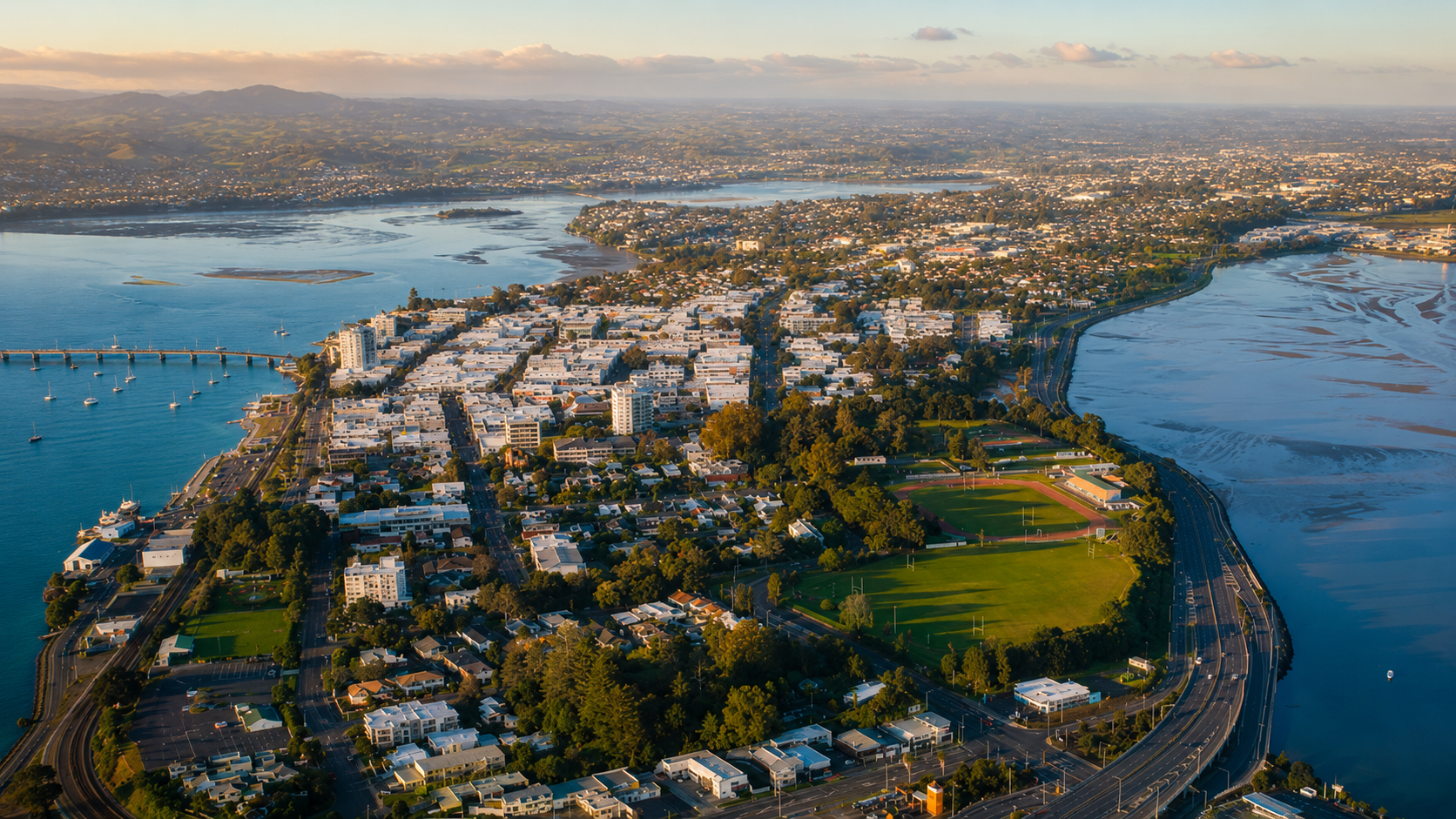
Tauranga Property Market Snapshot
Tauranga is one of New Zealand's most expensive major centres outside Auckland and Queenstown, and it's also the fastest-growing main centre in the country (Stats NZ 2023 Census).

Tauranga sits between Auckland and the inland centres
Indicative median house prices, 2026.
Tauranga's typical gross yield runs 3.5% to 4.6%, lower than Hamilton or Christchurch, but the coastal premium suburbs add a short-term rental story you don't get in either of those cities.
The latest data puts the Tauranga City median at $890,000 as at March 2026, with the Bay of Plenty regional median at $810,000 and Cotality's January 2026 Home Value Index showing the typical Tauranga dwelling at around $931,000. Prices are up about 2.86% year on year, ahead of the national HPI which lifted just 0.2% over the same period.
It's a two-speed market. Inland city stock sits in buyer-friendly territory with elevated inventory and days-to-sell above the long-term average. The premium coastal suburbs are running their own race: Mount Maunganui is at 31 days to sell, Papamoa Beach at 29 days, and Papamoa Beach was up 10.1% year on year to a $1,040,000 median in March 2026.
Pick your situation. We'll tell you what the Tauranga market is doing for you right now.
Inventory is elevated across most of the city and negotiation is the norm. Premium coastal stock at the Mount and Papamoa Beach is tighter, so the right approach depends entirely on which Tauranga you're buying in.
Median $890,000, up 2.86% YoYA household income around $105,000 to $115,000 is typically needed to service a mortgage at the Tauranga median with a 20% deposit. Parkvale, Gate Pa, Judea, and Greerton all sit under $750,000 and qualify for the Kāinga Ora First Home Loan with a 5% deposit.
Parkvale from $679,800Citywide gross yields sit around 3.5%, with 4.4% to 4.8% in Gate Pa, Hairini, Greerton, Bellevue, and Brookfield. The premium coastal suburbs are capital-growth and Airbnb plays, not cashflow plays. Mount Maunganui Airbnb listings averaged a median annual revenue of $76,119 on 58% occupancy in late 2025.
Inland yield 4.4% to 4.8%Tauranga Suburbs at a Glance
Tauranga is really three property markets bolted together: the inland city suburbs, the coastal premium strip from Mount Maunganui through Papamoa, and the Western Bay lifestyle areas. Click a suburb to see its median price, who's buying there, and how the lending picture changes.
Mount Maunganui
The flagship coastal suburb. Premium prices, fast days-to-sell, and one of NZ's busiest short-term rental markets. Capital growth and Airbnb plays, not cashflow plays. Coastal hazard insurance and STR rules are critical here.
Parkvale, Gate Pa, Judea, and Greerton sit between $679,800 and $717,750. They're zoned for infill development under MDRS and NPS-UD intensification, so townhouse stock is increasing. Hairini, Bellevue, Brookfield, Welcome Bay, and outer Papamoa cover the next band up to $950k.
The highest gross yields on three-bedroom stock are concentrated inland: Gate Pa and Hairini at 4.8%, Greerton at 4.6%, Judea, Bellevue, and Brookfield at 4.4% to 4.5%. The premium coastal suburbs sit well below city average on long-term rental yield, they're capital-growth and short-term rental plays.
Papamoa Beach was up 10.1% YoY to a $1,040,000 median, while Papamoa overall is down 4.6% on heavy new-build supply. Omokoroa is down 2.9%. Greerton, Parkvale, and Gate Pa have lifted 3% to 5% on first-home demand.
Buying Your First Home in Tauranga
Tauranga is one of the harder first-home markets in NZ on price, with a house-price-to-income ratio above 6 times. But the inland affordable suburbs (Parkvale, Gate Pa, Greerton, Judea) still have plenty of stock under $750,000, and the Kāinga Ora First Home Loan opens up almost the entire city if your income fits the cap.
The deposit reality in Tauranga
At the Tauranga City median of $890,000, a full 20% deposit is $178,000. Through the Kāinga Ora First Home Loan, a 5% deposit takes you down to $44,500. That's the gap between "saving for another four years" and "buying this year".
How the First Home Loan (Kāinga Ora) works
The First Home Loan is a 5% deposit scheme underwritten by Kāinga Ora and offered through select participating lenders. To qualify, you need to:
- Be over 18 and a New Zealand citizen, permanent resident, or resident visa holder.
- Be a first home buyer (or a previous homeowner in a similar financial position).
- Earn under $95,000 before tax as an individual buyer, $150,000 as an individual with dependants, or $150,000 combined for multiple buyers.
- Have a minimum 5% deposit of the purchase price.
- Buy the home as your primary place of residence.
There is no regional house price cap on the First Home Loan, the regional caps were removed in June 2022. It's the income caps and the lender's serviceability assessment that determine what you can buy. Full eligibility details sit in the Kāinga Ora First Home Loan brochure.
A Lender's Mortgage Insurance premium of around 0.5% of the loan amount also applies, payable upfront or added to the loan over its lifetime.
Which lenders offer the First Home Loan?
Eight lenders are currently participating: ASB, Westpac, Kiwibank, The Co-operative Bank, SBS Bank, Unity, Nelson Building Society, and NZHL.






Building Society
ANZ and BNZ are not on the panel, which matters: if you're going low-deposit, your lender shortlist is narrower than for a standard application. We'll match you to the participating lender most likely to approve your specific situation.
Tauranga-specific FHB challenges to plan for
- Coastal insurance access. Properties in Papamoa, Mt Maunganui, Pilot Bay, Omokoroa, and Maketu can face escalating premiums or outright denial from insurers like Tower. No insurance, no mortgage. Always include an insurance condition in your sale and purchase agreement.
- Greenfield land contracts. Buyers attracted to Tauriko West, Te Tumu, and Papamoa East subdivisions sign 10% deposit contracts with sunset clauses and multi-year settlement periods. Bank pre-approval at signing is indicative only, final credit is confirmed near settlement, after a fresh income and valuation check.
- High development contributions. Tauranga City Council's 2025/26 citywide DC for a 3-bedroom dwelling is $34,169, up 73% over four years. The DC is passed through to your purchase price in any new build.
- Auckland migration pressure. A net 5,106 Aucklanders moved to Tauranga between 2018 and 2023, and the migration pipeline is still adding demand at the city's price point.
KiwiSaver is usually part of the deposit rather than the whole thing. You can withdraw from your KiwiSaver if you've been a member for at least three years and leave at least $1,000 behind. For most Tauranga FHBs that means combining KiwiSaver with cash savings, a gift, or a guarantor.
A note on the First Home Grant: the Government closed the grant to new applications on 22 May 2024. It is no longer available.
Is this your situation?
You and your partner have around $25,000 in savings and a combined $50,000 in KiwiSaver. That's $75,000 together, about 10.4% of a $720,000 Greerton home. Your bank has told you that you need 15% to 20%, so you've put it on hold.
Here's how the picture changes with the First Home Loan: the same $75,000 is enough to buy at 5% deposit through one of the eight participating lenders. We'd model your full numbers, work out which lender is most likely to approve you, and tell you honestly whether to move now or save for another six months.

Investing in Tauranga Property
Tauranga's investor case is split: solid long-term capital growth, weak gross yields on premium coastal stock, and strong short-term rental income at the Mount and Papamoa Beach.
Yields around 3.5% citywide with 4.4% to 4.8% in Gate Pa, Hairini, Greerton, Bellevue, and Brookfield. Premium coastal sits at 2.6% to 3.1% on long-term rental, well below city average.
20-year capital growth ~4.64% per year (Tauranga City). Long-term track record outperforms most NZ centres on price growth, even as gross yield trails Hamilton or Christchurch.
Auckland migration drives demand. Net 5,106 Aucklanders moved to Tauranga between 2018 and 2023. Tauranga's 65+ population share is 19.4%, well above the 16.6% national average, the retiree market is structural.
New-build supply pipeline. Tauriko West, Te Tumu, Papamoa East, and Pyes Pa West are all active. New builds qualify for 20% deposit investor LVR versus 30% for existing.
Short-term rental income at the Mount and Papamoa
Mount Maunganui and Papamoa Beach are two of New Zealand's busiest short-term rental markets. November 2025 to April 2026 medians, filtered to listings with confirmed bookings:
The trade-off is coastal hazard, insurance availability, and short-term rental treatment, not zoning or earthquakes. Interest deductibility was fully restored from April 2025, the new-build investor LVR is 20%, and from December 2025 RBNZ allows up to 10% of new investor lending above 70% LVR. We cover the lending nuances in detail in the next section.
Read our full Property Investment guideNew Builds and Tauranga's Growth Corridors
A growing share of Tauranga buying is happening in new-build greenfield, partly because new builds qualify for lower deposit thresholds, partly because the city's massive growth pipeline is concentrated in a handful of corridors.
Owner-occupiers can stretch to a 90% LVR and investors to 80%, instead of the standard 80% and 70% caps that apply on existing homes.
(
(
Major growth areas, 2026
The most significant active greenfield development in the region. Phase 1 will deliver 2,400 homes with SH29 access works underway. First houses 2027.
Papamoa East masterplanned area. Heavy planning delays as at April 2026, with TCC voting to progress rezoning under incoming legislation rather than seek an exemption.
Established and ongoing. New-build supply is heavy, and Papamoa overall is down 4.6% YoY on that supply weight.
Southern Tauranga growth area. Established new-build pipeline. Pyes Pa average sits at $1,018,400.
Southern Tauranga premium lifestyle area. Active, with medians in the upper band.
Western Bay peninsula lifestyle, 25km north of Tauranga. Ongoing growth area, but down 2.9% YoY on slower buyer demand.
Why new builds make finance easier
Owner-occupiers can borrow up to 90% and investors up to 80%, instead of the 80% and 70% caps that apply to existing homes.
Your KiwiSaver first home withdrawal can be used for new-build deposits exactly as it can for existing homes. No extra hoops.
Construction loans are interest-only while the house is being built. You're not paying full repayments while you wait to move in.
Tauranga's $34,169 development contribution per 3-bedroom dwelling is rolled into your purchase price on every new build, and greenfield sunset clauses can bite. We'll match you to a lender whose construction policy fits the contract.
Coastal Hazards, Reverse Mortgages, Airbnbs & Lifestyle Blocks: What Makes Tauranga Lending Different
Five Tauranga-only issues that no broker outside the Bay handles in depth, and that directly affect whether your mortgage gets approved. Tap any to expand.
Tauranga's most material lending issue right now is not the bank, it's the insurer. If you can't insure a coastal property, the bank can't lend on it, and insurer red-listing of high-risk coastal zones is escalating.
Updated 2025 coastal inundation mapping. Tauranga City Council received updated coastal flooding modelling from Bay of Plenty Regional Council, replacing the 2019 harbour inundation maps. TCC's coastal erosion and harbour inundation information now allows property-level assessment under the National Policy Statement for Natural Hazards 2025 (TCC coastal erosion).
Areas at risk (BOPRC mapping)
- Papamoa Beach, active erosion, low-lying inundation
- Mount Maunganui main beach, active erosion, storm surge
- Pilot Bay, harbour inundation
- Omokoroa, coastal cliff erosion
- Maketu, estuary and open coast
- Pukehina, open coast erosion
The January 2026 storm event. On 21 January 2026, record Tauranga rainfall triggered devastating landslides at Mauao, Mount Maunganui. By March 2026, TCC had spent over $2.4 million on response, with a further $8.6 million budgeted for the next financial year. This event is now part of how lenders, insurers, and valuers assess Mauao-adjacent stock.
How insurers are responding. Tower has emerged as the leading insurer actively red-listing coastal properties in high-risk zones. Properties may face premium increases of hundreds to thousands of dollars per year, or outright refusal of cover. When insurance is denied, an existing mortgage holder is in breach of mortgage conditions, all mainstream lenders require the property to be insured.
What we do about it. We always check the BOPRC BayHazards viewer and TCC inundation viewer before you go unconditional, recommend an insurance condition in your sale and purchase agreement, and flag suburbs and streets where Tower or other insurers are known to be cautious. That stops you from buying a house the bank can't fund six weeks later.
Tauranga has one of New Zealand's highest concentrations of retirees, 19.4% of the Bay of Plenty population is aged 65+, against the national 16.6%. The "Auckland to Tauranga at 65" pipeline is a structural driver of demand and a significant chunk of our Tauranga lending workload.
Standard mortgages over 65
Under the Credit Contracts and Consumer Finance Act and the Responsible Lending Code, banks must verify lending is affordable across the full loan term, but there is no legislated maximum age, and banks can't discriminate by age under the Human Rights Act. What banks need is an exit strategy: sufficient retirement income (NZ Super and investment income) to service the loan, or a credible exit (planned sale of another property, downsizing, estate proceeds). The July 2024 CCCFA amendments loosened prescriptive expense checking, giving lenders more flexibility on retirement-stage applicants.
Reverse mortgages, the Heartland Bank product
Heartland is the dominant NZ reverse-mortgage provider. In the year to June 2025, NZ reverse-mortgage lending grew 15.5% to $1.23 billion, with a forecast 18% growth in the following year.
SBS Bank offers a competing product, SBS Unwind, also at 7.99% p.a. floating, with LVR schedules from 15% at age 60 up to roughly 50% at age 95.
Bridging finance for the Auckland-to-Tauranga move
A common scenario: sell Auckland home for $1.2m equity, buy in Bethlehem or Welcome Bay at $900k, take a small mortgage or none at all. Where the Auckland sale hasn't settled when the Tauranga purchase needs finance, a specialist bridging loan is required, we handle these regularly and know which lenders are most flexible on bridging.
Mount Maunganui and Papamoa Beach are two of New Zealand's busiest short-term rental markets, 664 and 455 active Airbnb / Bookabach listings respectively. The mortgage rules around them confuse a lot of buyers.
Holiday homes are classified as investment properties for lending
Minimum 35% deposit (65% LVR) for properties used personally without rental income. Full income servicing assessment is done without rental income offsets. Some banks may consider owner-occupier rates (20% deposit) if the borrower can demonstrate the property is genuinely for personal use only and their primary residence is elsewhere, but it's case-by-case with strict documentation.
Short-term rental income is NOT counted in serviceability
This is the big one. Across all major NZ banks, Airbnb and Bookabach income is excluded from standard mortgage serviceability calculations because income is seasonal and variable, depends on active management, and platforms can change policies, while councils can change short-term rental bylaws.
IRD and GST
Short-term rental income is treated differently from long-term residential rental for tax. GST registration may be required above the $60,000 threshold. We recommend specialist tax advice before settling on any high-revenue Airbnb purchase.
Tauranga's council position
Unlike Christchurch, Queenstown, or Rotorua, Tauranga has no specific short-term rental bylaw or registration scheme as at May 2026. Short-term rentals are regulated through the Tauranga City Plan as Residential Visitor Accommodation (RVA), a permitted activity in most residential zones provided you meet the standards (maximum 6 guests, on-site parking, Building Code compliance). Higher-density zones may require resource consent, so the zone of the specific property matters.
National-level government regulation of short-term rentals is being discussed and could change the landscape over the next few years, but as at today, the regulatory risk in Tauranga is materially lower than in cities that have already moved.
Rural lifestyle properties are clustered around Pyes Pa rural (south Tauranga), Whakamarama (inland from Omokoroa), Te Puna (north), Aongatete and Katikati hinterland, and the Pukehina area. They attract retirees, smallholders, and families wanting semi-rural living within commute distance of the Mount.
Bank lending depends on zoning, not the postcode
The critical line is the 4-hectare threshold. Above that, or where there's significant agricultural income, banks typically apply rural lending criteria with a 35% to 40% deposit and specialist credit assessment. Specialist rural lenders (Rabobank, Heartland) come into play.
Property-specific checks lenders and valuers will run
Bore water needs a potability test; tank systems need minimum volume. Septic systems that are non-compliant or at-capacity flag valuations. Unformed or legal-road-only access dramatically reduces lendability. Any unauthorised commercial use of rural land affects lending. Subdivision potential needs to be verified against actual zoning, not the agent's pitch.
We know which lenders are most comfortable on which side of the 4-hectare line, and which valuers handle Western Bay rural stock.
Tauranga has some of the highest development contributions in New Zealand.
These DCs are passed straight to buyers. In greenfield subdivisions, developers pay TCC at subdivision approval and roll the cost into section prices and house-and-land package pricing. For a 10-unit townhouse build, the DC liability alone exceeds $341,690 before any construction or infrastructure connection cost. Buyers don't always understand that a meaningful chunk of their purchase price is a council infrastructure charge being passed through.
Sunset clauses and the 2025 buyer-protection vote
Parliament voted down the Property Law (Sunset Clauses) Amendment Bill in 2025, which would have restricted developers from cancelling off-plan contracts under sunset clauses without buyer consent. As a result, developers retain the right to cancel and re-list at higher prices if market conditions improve materially during the development period.
Standard structure of a Tauranga greenfield off-plan contract: 10% deposit at signing held in a trust account, a sunset clause typically 2 years from contract date (the minimum banks require for developer pre-sale funding), and settlement on title issue with buyers needing to arrange final finance approval within roughly 30 days of title.
- Independent legal advice before signing the contract.
- Negotiate the longest sunset clause your developer's funder will accept.
- Treat any bank pre-approval as indicative only, plan for re-approval near settlement.
- Build a buffer for valuation shortfall on completion (banks lend on completed-build valuation, not contract price).
We handle these contracts regularly and know which lenders take the most flexible view on long-settlement greenfield.
Most generic NZ mortgage advice is written for standalone-house buyers in non-coastal cities. We've placed loans on Mount Maunganui apartments. We've structured reverse mortgages for Auckland retirees moving to Bethlehem. We know which lender is most flexible on Tauriko West off-plan contracts, and which lifestyle-block lenders work the Western Bay. That knowledge is the actual reason to use a Tauranga-focused adviser over a generic call-centre line.
Your Tauranga Mortgage Adviser
Bank-side experience, deep Tauranga-specific lending knowledge, and a 100% online way of working that fits around your week, from Bethlehem to the Mount.

Bachelor of Finance, Masters of Engineering Management, and a decade inside the banking industry. That includes time as a Commercial Manager at ASB Bank, where he pioneered digital banking solutions for shared home ownership.
The bank-side experience means he knows how applications are assessed, what triggers declines, and how to structure lending so it gets approved. Seb is also an active property investor and developer, so he's been through the lending process himself, on both sides of the table.

Beka handles client and bank liaison and loan applications from start to finish. She specialises in working with first home buyers: KiwiSaver withdrawals, First Home Loans, deposit structuring, and everything in between.
If you're a Tauranga FHB navigating the 5% deposit route for the first time, Beka is the one walking you through every step.
Everything is online. The entire process, from the first chat to signing your loan documents, runs over Zoom, phone, and email. You don't need to come into a Tauranga office and we don't need to come to you. That's how most Tauranga clients prefer it: it fits around work, kids, and the school run from Bethlehem to the Mount.
Simpler is a registered Financial Service Provider (FSP761131) and operates under New Zealand's financial advice regulations.
What our clients say
Don't just take our word for it, hear from the people we've helped.










Tauranga Mortgage Questions, Answered
The questions we hear most from Tauranga buyers.
That depends on your income, your existing debts, your deposit, and the lender's test rate, not on the suburb. As a rough guide, most banks lend around 5 to 6 times annual household income, but the test rate they use is usually 1.5 to 2% above the actual rate you'd pay. With Tauranga City's median sitting at $890,000, a household income around $105,000 to $115,000 is typically needed to service a mortgage at the median with a 20% deposit. We run the numbers across multiple lenders so you know your real maximum.
Yes, but the binding constraint is insurance, not the bank. Tower has been actively red-listing high-risk coastal zones, and if you can't get insurance, you can't get a mortgage. Always check the TCC and BOPRC hazard maps before you go unconditional, and always include an insurance condition in your sale and purchase agreement. The new LIM rules (in force from 1 July 2025) make hazard notations more visible than ever.
Banks classify holiday homes as investment properties for lending. The standard requirement is 35% deposit (65% LVR) for personal-use holiday homes. Some banks will consider owner-occupier rates if you can demonstrate genuine personal use and your primary residence is elsewhere, but this is case-by-case with strict documentation.
No. Short-term rental income (Airbnb / Bookabach) is not counted in standard serviceability calculations at any major NZ bank. You need to demonstrate you can service the full mortgage from employment or long-term rental income alone. We can help you structure a long-term rental conversion where appropriate.
Yes. There's no legislated maximum age and banks can't discriminate by age. What banks need is an exit strategy, either retirement income (NZ Super and investments) sufficient to service the loan, or a credible exit (downsizing, sale of another property, estate proceeds). The July 2024 CCCFA amendments loosened expense checking, giving lenders more flexibility on retirement-stage applicants. We handle the Auckland-to-Tauranga move regularly, including bridging finance when the Auckland sale and Tauranga purchase don't line up neatly.
Heartland Bank is the dominant NZ reverse mortgage provider. Their current rate is 7.99% p.a. variable, with maximum LVR by age (20% at 60, 30% at 70, 50% at 90+). The average initial loan is $78,000, average borrower age is 73, and there's a no-negative-equity guarantee. SBS Bank offers a comparable product (SBS Unwind) at the same rate. Compounding is significant, $100,000 at 7.99% becomes over $465,000 in 20 years, so independent legal advice is mandatory. We work through the maths with you and your family before recommending anything.
Parliament voted down the Property Law (Sunset Clauses) Amendment Bill in 2025, so developers retain the right to cancel under a sunset clause and re-list at higher prices. Your 10% deposit is returned but you've missed out on the price growth. Get independent legal advice before signing, negotiate the longest sunset clause the developer's funder will accept, and treat any bank pre-approval as indicative only.
TCC's 2025/26 citywide development contribution is $34,169 per 3-bedroom dwelling, up from $19,708 in August 2021, a 73% increase over four years. Additional local DCs apply in Tauriko West, Te Tumu, West Bethlehem, and Papamoa East. The DC is rolled into the section price or house-and-land package, buyers effectively pay it without seeing it itemised.
The threshold is 4 hectares and zoning. Below 4 ha on a rural-residential or lifestyle zone, standard residential lending applies (80% LVR available). Above 4 ha, or where there's significant agricultural income, banks typically apply rural criteria with 35% to 40% deposit and specialist credit assessment. Specialist rural lenders (Rabobank, Heartland) come into play. Banks and valuers also scrutinise water supply, septic, access, and consent history.
Two-speed. Inland city stock sits in buyer-friendly territory with elevated inventory and days-to-sell above the long-term average. Premium coastal suburbs are tighter, Mount Maunganui's median days to sell is 31 days and Papamoa Beach is 29 days. The right negotiating position depends on which Tauranga you're buying in.
Parkvale ($679,800), Gate Pa ($681,750), Judea ($714,550), and Greerton ($717,750) are the most accessible Tauranga City suburbs in 2026. They're zoned for infill development under MDRS and NPS-UD, so townhouse stock is increasing in all four.
No. We run everything online: Zoom, phone, and email. You don't need to come into an office. Most Tauranga clients prefer it that way: it fits around work, kids, and a busy week. The application, document signing, and settlement all happen digitally.
Nothing. We're paid by the lender when your loan settles. There's no fee to you, no charge for the chat, and no obligation if you decide not to proceed.
Ready to Talk to a Tauranga Mortgage Adviser?
Whether you're buying your first home in Greerton, refinancing in Bethlehem, picking up an Airbnb at the Mount, retiring from Auckland to Pāpāmoa, building at Tauriko West, or buying a lifestyle block near Katikati, we'll compare 25+ lenders, factor in the Tauranga-specific quirks, and recommend the right deal for your situation.
- A real maximum borrowing number across multiple lenders
- A coastal insurance and hazard read on any address before you offer
- A KiwiSaver and First Home Loan deposit plan if you're an FHB
- An honest read on whether to buy now or save for six more months