
Mortgage Adviser Wellington: Free and Independent
Mortgage broking for Wellington buyers. We compare 25+ lenders, handle the Wellington-specific stuff like apartment lending and NBS ratings, and manage the whole application online.
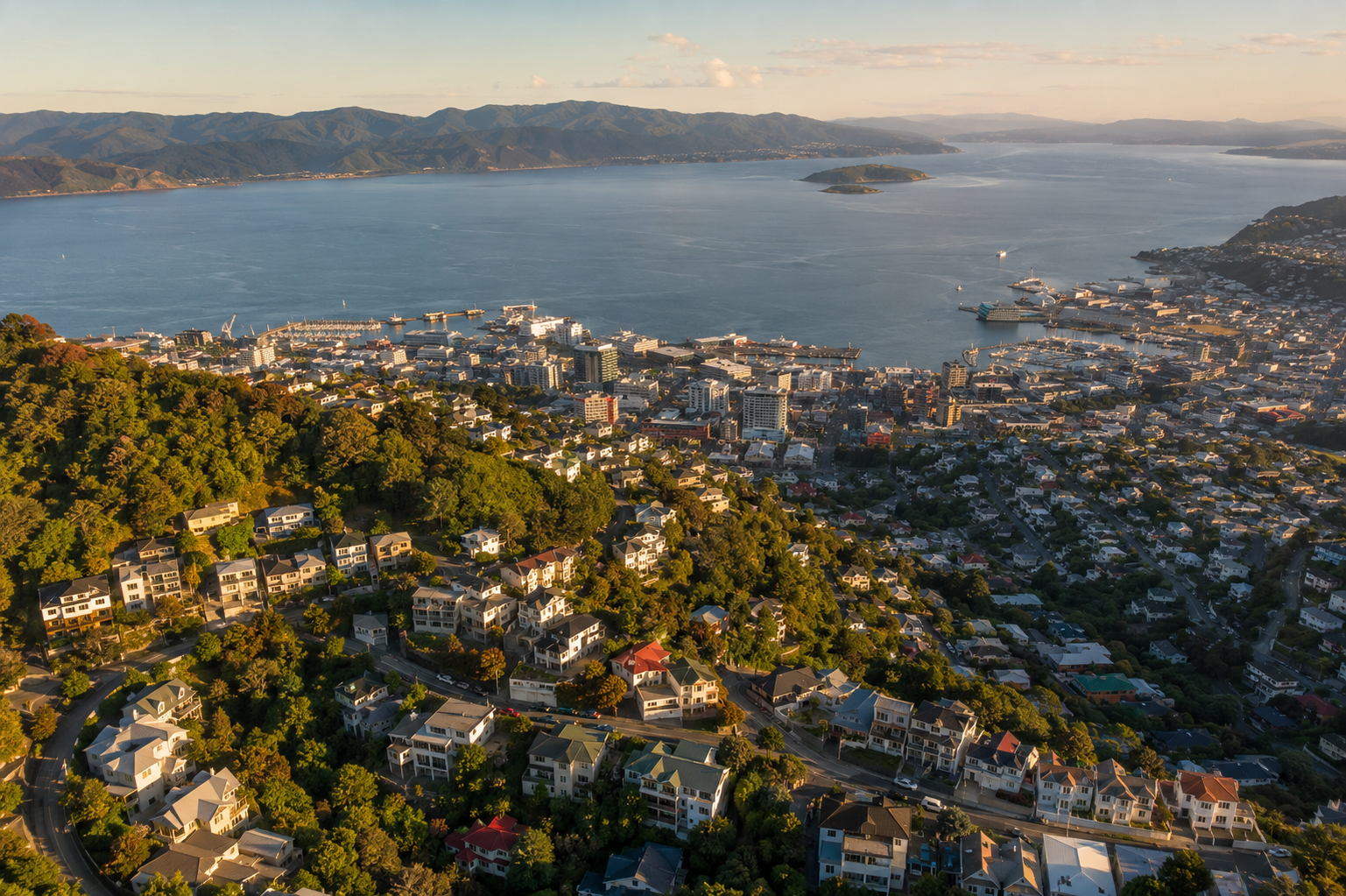
Wellington Property Market Snapshot
Wellington is in a different phase of the cycle to Auckland and Christchurch. Prices are well off their peak, inventory is high, and buyers are negotiating hard, which means there is genuine value here for the first time in years.

Wellington sits between Auckland and Christchurch on price
Indicative median sale prices across the three main centres, early 2026.
Wellington's regional median sits at $780,000, around 25% below Auckland and 11% above Christchurch. Wellington City is 26.4% off its October 2021 peak, with the market bottoming in December 2025 and a 2.7% recovery in the three months to March 2026 (Opes Partners).
Inventory is high. Wellington Region stock sat at 19 weeks in March 2026 against a long-term median of 15. Sales activity surged 12.8% year on year through mid-2025 as lower interest rates pulled buyers back in, and momentum has held into 2026 (Opes Partners, March 2026).
Pick your situation. We'll tell you what the Wellington market is doing for you right now.
Final sale prices are typically landing 5 to 8% below initial asking. Inventory is at 19 weeks, days on market are above the long-term average, and the pricing power has shifted. There's room to negotiate, room to take your time, and room to walk away from properties with NBS, cross-lease or coastal hazard issues that lenders won't fund.
Inventory 19 weeks, sales below asking 5 to 8%First home buyers have access to sub-$700,000 entry suburbs across Naenae, Cannons Creek, Titahi Bay and Tawa. Naenae at $574,650 and Cannons Creek at $561,550 are the most accessible price points in the region. With the First Home Loan, a 5% deposit on the regional median is just $39,000.
5% deposit on regional median: $39,000Wellington Region gross yield sits at 4.55 to 4.86% across houses, with Cannons Creek leading at around 5.1% (Opes Partners). Prices are 25 to 30% off peak, interest deductibility was fully restored from April 2025, and the new-build investor LVR sits at 20% deposit versus 30% for existing stock. Lower Hutt and Porirua are delivering yields above 4% with stronger sales activity than Wellington City itself.
New-build investor deposit 20%Wellington Suburbs at a Glance
Click a suburb on the map to see its average price, who's buying there, and how it stacks up. Wellington is really five property markets stacked together, Wellington City, Lower Hutt, Upper Hutt, Porirua, and the Kāpiti Coast, each with its own pricing, topography and buyer profile.
Cannons Creek
The most accessible price point in the Wellington region, with the strongest long-term capital growth of any Wellington suburb (8.1% per year since 2000). Top-yielding suburb for investors.
Naenae, Cannons Creek, Titahi Bay, Taita, Stokes Valley, Tawa, Trentham and Otaki are the entry-level Wellington suburbs in 2026. Naenae at $574,650 and Cannons Creek at $561,550 are the most accessible price points in the region.
Cannons Creek leads at around 5.1% gross yield with the strongest long-term capital growth of any Wellington suburb. Naenae sits above 5%, Titahi Bay around 4.2%, Petone around 3.7%. Wellington Central apartments at Pipitea hit roughly 6.0%, the highest in the region, though apartment-specific risks apply.
Wellington Central is the weakest precinct, with apartment values down 8.54% per year over the 24 months to March 2026. Mt Victoria is down 10.6% over two years. Eastbourne, by contrast, has recovered strongly with the median up 13.6% in the 12 months to May 2026.
Buying Your First Home in Wellington
Wellington FHBs have more options in 2026 than they have had in five years, but the rules around KiwiSaver, the First Home Loan, and Wellington's specific due diligence costs are confusing if you have not bought before.
How the First Home Loan (Kāinga Ora) works
The First Home Loan is a 5% deposit scheme underwritten by Kāinga Ora and offered through select participating lenders. To qualify, you need to:
- Be over 18 and a New Zealand citizen, permanent resident, or resident visa holder.
- Be a first home buyer (or a previous homeowner in a similar financial position).
- Earn under $95,000 before tax as an individual buyer, $150,000 as an individual with dependants, or $150,000 combined for multiple buyers.
- Have a minimum 5% deposit of the purchase price.
- Buy the home as your primary place of residence.
There is no regional house price cap on the First Home Loan. The regional caps were removed in June 2022. It's the income caps and the lender's serviceability assessment that determine what you can buy. Full eligibility details sit in the Kāinga Ora First Home Loan brochure.
A Lender's Mortgage Insurance premium of around 0.5% of the loan amount also applies, payable upfront or added to the loan over its lifetime.
KiwiSaver: the Wellington trap to know about
The KiwiSaver first-home withdrawal scheme has a regional house price cap that applies separately to the First Home Loan. For the Wellington Urban Area (Wellington City, Porirua, Lower Hutt, Upper Hutt, Kāpiti Coast), the existing-property cap is $750,000.
With Wellington City sitting at around $805,000 median, the KiwiSaver scheme only applies to existing properties below $750,000, a narrow window in the city itself, but plenty of room across Lower Hutt, Porirua, Upper Hutt, and Kāpiti. The cap doesn't apply to new builds.
Which lenders offer the First Home Loan?
Eight lenders are currently participating: ASB, Westpac, Kiwibank, The Co-operative Bank, SBS Bank, Unity, Nelson Building Society, and NZHL.






Building Society
ANZ and BNZ are not on the panel. That matters in Wellington: if you're going low deposit, your shortlist of lenders is narrower than for a standard application. We'll match you to the participating lender most likely to approve your specific situation.
Wellington-specific costs to budget for
Wellington adds a handful of due-diligence costs that don't usually apply elsewhere. Budget for these alongside your deposit:
- Detailed Seismic Assessment (DSA): $5,000 to $15,000 if a lender requires one for an apartment or multi-unit building.
- Weather-tightness specialist report: $500 to $1,500 for any property built between roughly 1992 and 2004 with monolithic plaster cladding.
- Cross-lease title review: typically $500 to $1,000 with your conveyancer to confirm flat plan accuracy and lease integrity before you go unconditional.
- Public sector employment scrutiny: Wellington lost roughly 10,000 jobs between October 2023 and early 2026, mainly in the public service. Lenders are still approving public sector applicants, but they're scrutinising restructure exposure more closely than they did pre-2024.
A note on the First Home Grant: the Government closed the grant to new applications on 22 May 2024. It is no longer available for any new buyer in Wellington or anywhere else.
Is this your situation?
You and your partner have around $25,000 in savings and a combined $50,000 in KiwiSaver. That's $75,000 together, a little over 10% of a $700,000 Lower Hutt or Porirua home. Your bank has told you that you need 20%, so you've put it on hold.
Here's how the picture changes with the First Home Loan: the same $75,000 is enough to buy at 5% deposit through one of the eight participating lenders, with $40,000 still left over for legals, building reports, the moisture report on a 1990s plaster home, and reserves. We'd model your full numbers and tell you whether to move now or save another six months.

Investing in Wellington Property
Wellington's investor case in 2026 is mixed but improving. Prices are 25 to 30% off peak, gross yields are recovering, and the new-build investor LVR exemption is genuinely useful here. The trade-off is seismic and insurance risk, not size or zoning.
Wellington Region gross yield 4.55 to 4.86% across houses. Cannons Creek leads at 5.1% with the strongest long-term capital growth (8.1% per year since 2000). Wellington Central apartments at Pipitea hit roughly 6.0%, the highest in the region, though apartment-specific risks apply.
Prices 25 to 30% off peak. Wellington City is statistically undervalued against its long-term trend, sitting 15.84% below trend in March 2026. The bottom was reached in December 2025 with a 2.7% recovery in the three months to March 2026.
New-build investor LVR is 20% deposit, versus 30% for existing properties under standard RBNZ LVR rules. The exemption applies for 20 years from the code-compliance certificate date, which makes new-build the cheap door in for Wellington investors.
Lower Hutt and Porirua are stronger than the city. Both deliver yields above 4% with stronger sales activity than Wellington City itself. Wellington City rents fell 7.46% in the 12 months to February 2026 as new townhouse supply hit the market, while the Hutt Valley and Porirua held up better.
The trade-off here is seismic and insurance risk, not size or zoning. Wellington apartments need to be assessed for NBS rating before lending. Hill section properties carry retaining wall liability. Coastal hazard zones on the Petone foreshore, south coast and Kāpiti are now more visible on LIMs since the natural-hazard reforms came in. Interest deductibility for investors was fully restored from April 2025. We cover all five issues in detail in Section 8.
Read our full Property Investment guideNew Builds and Wellington's Growth Areas
A growing share of Wellington buying is happening in the new build market, partly because new builds qualify for lower deposit thresholds, partly because Wellington's 2024 District Plan unlocked far more terraced and apartment supply across the inner city, and partly because new builds score 100% NBS by definition, no seismic hassles to navigate.
Owner occupiers can typically borrow up to 90% on fixed-price contracts (Westpac explicitly offers 90% for owner-occupied new builds), and investors can buy with 20% deposit versus 30% on existing stock under standard RBNZ LVR rules. The exemption applies for 20 years from the code-compliance certificate date.
(
(
Why new builds make finance easier in Wellington
Owner occupiers borrow up to 90%, investors at 20% deposit. Westpac New Build Loan sets out the 90% policy explicitly.
New builds score 100% NBS on completion. No DSA reports, no body corporate strengthening exposure, no banks declining on seismic risk. The Wellington-specific lending headache disappears.
Construction loans are interest only while the house is being built, so you're not paying full repayments while you wait to move in. KiwiSaver works for new build deposits the same way.
Major new build areas in Wellington
2,400 dwellings. EPA fast-track consent approved, Stage 1 commenced October 2024. Includes a planned retirement village, commercial area and school. 3-bed standalone build cost $480k to $675k, sections additional.
Premium Porirua new build suburb. Newer subdivision stock, family focused, the high end of the Porirua market.
Formerly Lincolnshire Farm. Sections plus build via Ground Up Homes and Russell Properties. Northern Wellington City growth zone.
Greenfield development pipeline in Northern Wellington. Long timeline, plenty of section options for owner-occupier and investor builds.
Modern Upper Hutt family subdivision. Recent sales $795,000 to $1,460,000. New builds qualify for 90% owner-occupier or 20% investor lending.
New 3-bed townhouses in Lower Hutt from around $600,000. Westpac flags this as one of the strongest value-buying areas in NZ.
New 3-bed townhouses in the northern Wellington City suburbs available under $800,000 as the District Plan intensification rolls out.
Wellington City's 2024 District Plan is final and legally binding. 3 storeys as of right in most residential zones, 6+ storeys near the CBD and key transport corridors, and minimum car parking removed. Significant new townhouse supply is rolling out in Newtown, Mt Cook, Berhampore, Petone and the northern suburbs. Source: Beehive announcement.
Banks vary on labour-only contracts (typically 40 to 60% LVR) and on long-settlement land contracts where settlement may be 12 to 24 months out. We'll match you to a lender whose construction policy fits your build type and walk you through the drawdown schedule before you sign.
NBS, Apartments, Hill Sections, Cross-Lease and Coastal Hazard
Five Wellington-specific issues that directly affect whether your mortgage gets approved and what deposit you'll need. Most generic NZ broker advice doesn't cover them, because outside Wellington they either don't exist or don't matter. Select a topic to expand.
NBS, the percentage of New Building Standard a building achieves, is the number that determines whether a Wellington property is lendable, and at what deposit. The Wellington Fault runs through the centre of the city, and stricter EPB obligations apply here than in Auckland.
| NBS rating | Classification | Lender treatment |
|---|---|---|
| 100%+ | Full code compliance | Normal lending and insurance |
| 67 to 99% | NZSEE-acceptable seismic risk | Mainstream lending generally available |
| 34 to 66% | Earthquake-risk (not legally EPB) | Increased scrutiny, conditional approvals, often higher deposit (30 to 40%) or specialist credit committee approval |
| Below 34% | Legally earthquake-prone | Most banks decline or require specialist credit committee approval |
| Below 20% | Extremely high risk | Effectively unlendable and uninsurable |
Sources: Alert Building Inspections, Building Inspections Wellington.
- The Building (Earthquake-prone Buildings) Amendment Act 2016 sets the legal threshold at 34% NBS, below that, owners face mandatory remediation or demolition timeframes.
- Wellington apartment owners have reported insurance premium increases of up to 320% in low-NBS buildings. One small block's premiums rose from ~$10,000 (2012) to over $42,000 (2019) at a 1% NBS-rated building.
- The September 2025 EPB reforms announced by the Government replace the NBS% measure with a risk-based system and exempt Auckland and Northland. Wellington retains high seismic zone status. Implementation is not expected until mid-2027, so lenders and insurers continue to use NBS% thresholds today.
- Kāinga Ora's Residential EPB Financial Assistance Scheme offers loans of up to $250,000 per unit for owner-occupiers facing hardship. The scheme closes 30 June 2027 with $10 million total funding.
We check the NBS rating, the body corporate's remediation plan, and the lender match before you waste a building report on a property the bank was never going to fund.
All major banks apply nationwide minimum-size policies on apartments. In Wellington, the NBS overlay sits on top of these standard rules, so a 50 sqm apartment in a 35% NBS building is treated very differently to the same apartment in a 90% NBS building.
| Bank | Min size for 20% deposit | Below minimum |
|---|---|---|
| ANZ | 38 sqm freehold, separate bedroom and living | 50% deposit; same applies to studios and leasehold |
| ASB | 40 sqm, studios without carparks accepted at 20% | Higher deposit required below 40 sqm |
| BNZ | 50 sqm | 35% deposit or decline. Strictest of the major banks |
| Kiwibank | 40 sqm | Higher deposit or decline |
| Westpac | 40 sqm | 50% deposit |
Sources: ANZ media release, July 2021; interest.co.nz, June 2021. Bank policies shift quietly; we re-verify before submitting.
- For buildings below the bank's NBS threshold (typically 67%), the bank will require a current DSA, evidence of a funded remediation plan if below 67%, additional deposit or specialist credit approval at 34 to 66% NBS, and decline below 34% NBS, regardless of how big the apartment itself is.
- Body corporate fees and seismic levies. In standard buildings, annual levies for a 2-bedroom Wellington apartment commonly run $3,000 to $8,000. For buildings facing strengthening, special levies can run into tens of thousands. Body corporate fees count as a committed expense in serviceability calculations.
- The Kaikoura context. The November 2016 earthquake fundamentally changed lender and insurer appetite for Wellington apartment stock. Three buildings were demolished, around 80 CBD buildings were assessed under emergency powers, and the Statistics House precast-floor-unit issue prompted re-assessment of similar buildings across the city.
- Leasehold apartments require 50% deposit from all mainstream banks.
We know which banks are comfortable with which Wellington apartment buildings. That stops you wasting time on a property the bank was never going to fund.
Wellington's topography means a large share of residential properties in Karori, Kelburn, Mt Victoria, Wadestown, Island Bay, Northland, Roseneath and Hataitai rely on retaining walls for driveways, building platforms and access. Hillside soils are dominated by weathered greywacke that behaves like soil when saturated, plus steep clay soils with poor drainage.
Sources: Building Inspections Wellington; DTCE landslides in Wellington.
- Banks rely on a registered valuation that accounts for retaining wall condition. A failing wall, or one with uncertain ownership (common on boundary walls between neighbours), can trigger a reduced valuation, conditional approval pending a geotechnical engineer's assessment, or decline if failure risk is imminent.
- Retaining wall costs. A simple timber wall replacement runs from around $20,000. A large engineered concrete wall on a difficult site can cost well over $100,000.
- Natural Hazards Commission (NHC) cover contributes up to $50,000 per property for retaining walls damaged by a natural hazard event, this is per property, not per wall. MAS extends standard house-insurance cover to $100,000 for retaining walls. Gradual deterioration is excluded from both NHC and most private insurance.
- Since 1 July 2025, councils must include a standardised natural-hazard section on LIMs with plain-language summaries and hazard mapping.
- Slope hazard ratings and retaining wall conditions are now more clearly disclosed than they were even 12 months ago.
- We work with the lenders and valuers most comfortable on Wellington hillside stock and tell you up front whether a property is going to clear valuation cleanly.
Cross-leases are widespread in Wellington, especially in older inner-suburban areas (Karori, Newtown, Kelburn, Miramar) and 1960s to 80s outer-suburban subdivisions across the Hutt Valley. Banks lend on cross-lease properties on similar terms to freehold if the title is clean. The problems start when:
- The flat plan does not match the actual building, extensions, garages, decks added without updating the registered plan.
- Building work has been done without council consent.
- Restrictive covenants require neighbour consent for alterations.
- The original lease document is defective, poorly drafted 1970s leases are common offenders.
Where any of those exist, banks may decline, impose conditions, or require legal opinion on title. Discovering a flat plan defect at auction is particularly painful. Conversion to freehold is the long-term fix.
Total all-in across a typical two-flat property is $30,000 to $50,000 shared between owners. We review the cross-lease title before you make an offer, flat plan, alterations, lease integrity, and tell you whether the bank is likely to lend.
Greater Wellington Regional Council sea-level rise modelling identifies several Wellington areas as subject to coastal inundation risk: Petone foreshore (Lower Hutt), Eastbourne (Lower Hutt), South Wellington coast (Lyall Bay, Seatoun, Miramar Peninsula foreshore), Plimmerton and Pukerua Bay (Porirua), and Raumati Beach and Paraparaumu coast (Kāpiti).
A 2025 Victoria University study found coastal subsidence rates of up to 10mm per year at some Wellington reclaimed land sites, effectively doubling the relative sea-level-rise rate at those locations.
Sources: GWRC sea-level rise mapping; Victoria University coastal subsidence research, April 2025.
- Since 1 July 2025 (expanded by regulations from 17 October 2025), councils must include a standardised natural-hazard section on LIMs with plain-language summaries and hazard mapping. Coastal hazard information is now disclosed up front.
- Lenders: banks reviewing valuations on coastal properties will increasingly see hazard notations. Section 73 LIM warnings on natural hazards can trigger conditional approval or decline if insurance becomes unavailable.
- Insurers are still grappling with the implications of the new disclosure rules. Some coastal properties are becoming harder or more expensive to insure.
- Resale: properties with hazard notations may face a smaller buyer pool over the next few years.
We track which lenders and insurers are most comfortable on which Wellington coastal pockets and flag the risk before you go unconditional.
Most generic mortgage advice in NZ is written for standalone-house buyers in low-hazard cities. NBS ratings, post-Kaikoura apartment paperwork, hillside retaining walls, cross-lease defects, and the new natural-hazard LIM rules don't even feature on most national broker pages, because outside Wellington, those issues either don't exist or don't matter. We've placed loans on apartments with seismic strengthening plans, worked through cross-lease title defects in Karori, and know how to structure approvals on Petone foreshore properties. That knowledge is the actual reason to use a Wellington-focused adviser over a generic call-centre line.
Your Wellington Mortgage Adviser
Wellington clients served entirely online, with bank-side experience and a way of working that fits around work, kids, and the southerly.

Bachelor of Finance, Masters of Engineering Management, and a decade inside the banking industry, including time as a Commercial Manager at ASB Bank, where he pioneered digital banking solutions for shared home ownership.
The bank-side experience means he knows how applications are assessed, what triggers declines, and how to structure lending so it gets approved. Seb is also an active property investor and developer, so he's been through the lending process himself, on both sides of the table.

Beka handles client and bank liaison and loan applications from start to finish. She specialises in working with first home buyers: KiwiSaver withdrawals, First Home Loans, deposit structuring, and everything in between.
If you're a Wellington FHB navigating the 5% deposit route or working through the KiwiSaver $750k cap for the first time, Beka is the one walking you through every step.
Everything is online. The entire process, from the first chat to signing your loan documents, runs over Zoom, phone, and email. You don't need to come into a Wellington office and we don't need to come to you. That's how most Wellington clients prefer it: it fits around work, kids, and the southerly. The application, document signing, and settlement all happen digitally.
Simpler is a registered Financial Service Provider (FSP761131) and operates under New Zealand's financial advice regulations.
Wellington Mortgage Questions, Answered
The questions we hear most from Wellington buyers.
That depends on your income, your existing debts, your deposit and the lender's test rate, not on the suburb. As a rough guide, most banks lend around 5 to 6 times annual household income, but the test rate they use is usually 1.5 to 2% above the actual rate you'd pay. With Wellington Region's median sitting at $780,000, the gap between borrowing power and target price is smaller than in Auckland but tighter than Christchurch. We run the numbers across multiple lenders so you know your real maximum, not just one bank's estimate.
Naenae, Cannons Creek, Titahi Bay, Taita, Stokes Valley, Tawa, Trentham and Otaki are the entry-level suburbs in 2026. Naenae at $574,650 and Cannons Creek at $561,550 are the most accessible price points in the region (Opes Partners). The Hutt Valley and Porirua are where most FHB activity concentrates.
Sometimes, it depends on the rating and the body corporate plan. Below 34% NBS, most banks decline. Between 34% and 66% NBS, banks will assess case by case, usually requiring a current Detailed Seismic Assessment, evidence of a funded remediation plan, and often a higher deposit. At 67% NBS and above, standard lending applies. We know which banks take a more flexible view.
Above each bank's minimum size threshold, you can get standard 20% deposit lending. Below the threshold you'll typically need 35 to 50%. ANZ requires 50% on apartments under 38 sqm and on leasehold or studio apartments; BNZ requires 35% (or declines) below 50 sqm; ASB, Kiwibank and Westpac require higher deposits below 40 sqm. The NBS rating sits on top of those rules. We'll match the apartment to the right bank.
Most banks lend on cross-lease properties on similar terms to freehold if the title is clean. Issues arise when the flat plan doesn't match the actual building, building work was done without consent, or the lease document itself is defective. In those cases banks may decline, impose conditions, or require legal opinion. Conversion to freehold costs around $15,000+GST per title plus council fees, takes 8 to 9 months, and can add 7 to 20% to value on resale.
Get a specialist weather-tightness report before you go unconditional. Wellington's leaky-building era runs roughly 1992 to 2004, with monolithic plaster cladding over untreated kiln-dried framing without drainage cavities. Banks will require a moisture report on suspect-era cladding before approving finance. A specialist report runs $500 to $1,500 and saves you from inheriting a $250,000+ remediation bill.
Yes, check them before going unconditional. Banks rely on a registered valuation that accounts for retaining wall condition. A failing wall can trigger a reduced valuation, conditional approval pending a geotechnical engineer, or outright decline if failure is imminent. The Natural Hazards Commission contributes up to $50,000 per property for walls damaged by natural hazard events, but gradual deterioration is excluded from both NHC and most private insurance.
Buyers on the Petone foreshore, Eastbourne, the south Wellington coast, and Plimmerton/Pukerua Bay should know that GWRC sea-level rise modelling flags these areas, and that since 1 July 2025 LIMs include a standardised natural-hazard section. Lenders generally require buildings and contents insurance as a condition of lending; if a property becomes uninsurable, lending falls over. Insurance premiums on coastal Wellington stock have started climbing.
Yes, but the public sector restructuring of 2024 to 2026 means lenders are scrutinising restructure exposure more than they did pre-2024. Roughly 10,000 Wellington jobs disappeared between October 2023 and early 2026, mostly in the public service. Tenure, contract type, and any indication of upcoming review all matter. We help you frame the application correctly.
Firmly buyer's. Inventory sits at 19 weeks in March 2026 (against a long-term median of 15 weeks), days to sell are above the 10-year average, and final prices are typically landing 5 to 8% below initial asking. The market bottomed in late 2025 and is in early recovery.
For the Wellington Urban Area (Wellington City, Lower Hutt, Upper Hutt, Porirua, Kāpiti Coast), the KiwiSaver first-home withdrawal price cap on existing properties is $750,000. The cap doesn't apply to new builds. With Wellington City sitting around $805,000 median, the existing-property cap rules out central Wellington for KiwiSaver users, but plenty of options remain across the Hutt Valley, Porirua and Kāpiti.
No. We run everything online, Zoom, phone, and email. You don't need to come into an office. Most Wellington clients prefer it that way: it fits around work, kids, and the southerly. The application, document signing, and settlement all happen digitally.
Nothing. We're paid by the lender when your loan settles. There's no fee to you, no charge for the chat, and no obligation if you decide not to proceed.









Ready to Talk to a Wellington Mortgage Adviser?
Whether you're buying your first home in Naenae, refinancing in Khandallah, picking up a Te Aro apartment, working through a cross-lease title in Karori, or building at Plimmerton Farm, we'll compare 25+ lenders, factor in the Wellington-specific quirks (NBS ratings, hillside retaining walls, cross-lease defects, coastal hazard LIMs) and recommend the right deal for your situation.
- A real maximum borrowing number across multiple lenders
- A clear answer on which lender suits your apartment, NBS, cross-lease or hill-section situation
- A KiwiSaver and First Home Loan deposit plan that works around the $750k Wellington cap
- An honest read on whether to buy now or save for six more months